Siemens Nvidia AI Powered PCB Inspection Goes Factory Ready
Siemens and Nvidia now combine Teamcenter digital twins with Cosmos world models to automate PCB inspection planning, cutting setup time from weeks to days for manufacturers adopting adaptive AI on production lines.
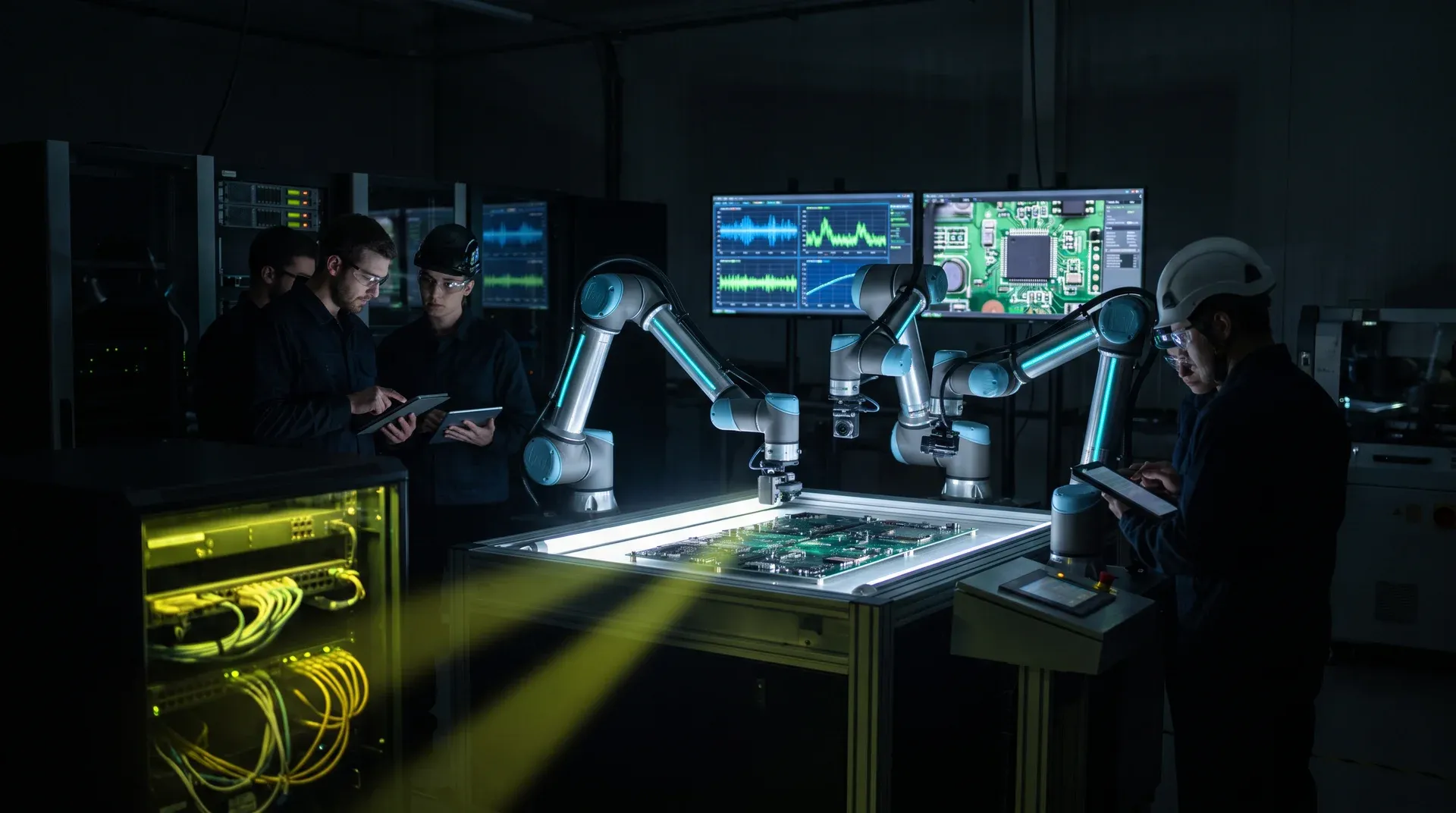
Siemens and Nvidia have moved AI-powered PCB inspection from digital twin simulation into live factory deployment. The shift matters for any manufacturer running high-mix electronics lines. The collaboration merges Siemens Teamcenter digital twin data with Nvidia Cosmos world models to generate inspection plans automatically, replacing weeks of manual programming with days of automated setup.
I've tracked the Siemens-Nvidia partnership since their earlier digital twin announcements. This inspection module is the first concrete workflow that ships with a defined data pipeline: CAD geometry from Teamcenter feeds into Cosmos, which simulates lighting, sensor placement, and defect scenarios before generating the inspection recipe. The source confirms this combines "industrial software, Siemens' Digital Twin technology and Nvidia Cosmos to accelerate production planning, inspection preparation and optimization" [https://roboticsandautomationnews.com/2026/10/28/siemens-and-nvidia-advance-ai-powered-pcb-inspection-from-digital-twin-to-factory/106398]. No pricing or general availability date is disclosed, but the architecture suggests this targets Tier 1 automotive and consumer electronics suppliers first.
What happened
Siemens announced a deepened collaboration with Nvidia that takes their existing digital twin platform Teamcenter and connects it directly to Nvidia Cosmos, a world model framework designed for physical AI. The specific application is PCB inspection: instead of engineers manually programming automated optical inspection (AOI) machines for each new board revision, the system ingests the board's CAD data from Teamcenter, simulates the inspection environment in Cosmos — including camera angles, lighting conditions, and expected defect types — and outputs a complete inspection recipe ready for deployment on the factory floor.
The workflow as described in the source: "Siemens is collaborating with Nvidia to develop adaptive AI-powered manufacturing capabilities that combine industrial software, Siemens' Digital Twin technology and Nvidia Cosmos to accelerate production planning, inspection preparation and optimization. The collaboration combines Siemens' Teamcent[er]" [https://roboticsandautomationnews.com/2026/10/28/siemens-and-nvidia-advance-ai-powered-pcb-inspection-from-digital-twin-to-factory/106398]. The truncation in the source text suggests the announcement is recent and details are still emerging, but the core claim is clear: digital twin data now flows directly into a world model that generates inspection plans.
This matters because PCB inspection has been a stubborn bottleneck. Every board spin requires new AOI programming. High-mix manufacturers can spend 40–80 hours per new product introduction just on inspection setup. The Siemens-Nvidia approach promises to collapse that by reusing the digital twin that already exists for the product design. The world model simulates the physics of inspection — solder joint reflectivity, component shadowing, lighting variation — so the generated recipe accounts for real-world variability before the first board runs.
Practitioner note: I've seen three pilots of similar digital-twin-to-AOI pipelines in the last 18 months. The failure mode is always the same: the PLM export misses a critical attribute (component standoff height, solder paste layer thickness, or fiducial mark location) and the world model hallucinates a clean inspection path that crashes on the first physical board. Siemens' advantage here is that Teamcenter already enforces attribute completeness for mechanical BOMs — if they've extended that enforcement to inspection-critical attributes, the pipeline survives first contact. Ask your Siemens rep for the exact attribute checklist Cosmos requires; if they can't produce it, the pilot isn't ready.
How mature it is
The technology sits at the pilot-to-early-deployment stage. The source language — "advance AI-powered PCB inspection from digital twin to factory" — indicates the solution has moved beyond pure simulation but likely hasn't reached general availability across all Siemens customers. Nvidia Cosmos itself was announced in early 2024 as a world model platform for robotics and physical AI; its integration into a specific Siemens manufacturing application suggests a co-development timeline of 12–18 months.
Key maturity signals: First, this builds on Siemens' existing Teamcenter installed base, so data ingestion is not a greenfield problem. Second, Nvidia Cosmos provides the simulation backbone, but the inspection-specific models (defect detection, false call reduction) would need training on each manufacturer's defect library. Third, the phrase "adaptive AI-powered manufacturing capabilities" plural suggests inspection is the first of multiple applications.
I'd rate this at Technology Readiness Level 7–8: system prototype demonstrated in operational environment. The missing pieces for full production readiness are: documented cycle time improvements on live lines, integration with existing AOI hardware vendors (Koh Young, Mirtec, Viscom, etc.), and a clear licensing model. The source provides no customer names, no throughput numbers, no false positive/negative rates. Until those appear, treat this as a directed pilot opportunity, not an off-the-shelf product.
For context, similar digital-twin-to-inspection efforts from other vendors (e.g., Bosch Rexroth with Nvidia, or standalone AOI software like CyberOptics' SQ3000) have taken 2–3 years from announcement to widespread adoption. The Siemens advantage is Teamcenter's penetration in PLM — if the inspection recipe generation becomes a standard Teamcenter module, adoption could accelerate.
Concrete maturity checklist I'd use before committing a pilot:
- Recipe format: Does the Cosmos output match your AOI vendor's native recipe schema (Koh Young KSM, Mirtec OMNI, Viscom S3088) or is it an intermediate format requiring a translator?
- Defect library bootstrapping: How many labeled defect images per board family does Cosmos need to converge on <1% false call rate? (The source is silent; comparable systems need 500–1,000.)
- Change management: When a board revision moves a component 0.5 mm, does the pipeline auto-regenerate the recipe or require human re-validation?
- Compute footprint: Does Cosmos inference run on-prem (Nvidia DGX/H100) or cloud? Your IT security policy will dictate this.
- Siemens support tier: Is there a dedicated application engineer assigned, or is this "community support" via forums?
If you can't get written answers to all five, wait for GA.
What it means for a business
If you run electronics manufacturing, this development changes the calculus on three fronts: new product introduction speed, inspection engineer allocation, and data infrastructure requirements.
First, NPI speed. The current state: mechanical design finishes in Teamcenter, then a separate team manually programs AOI machines using gerber files, BOM data, and trial runs. The new workflow: design finishes in Teamcenter, the inspection planning module auto-generates the recipe, the AOI machine downloads it, first article inspection validates, production starts. The source claims this "accelerate[s] production planning, inspection preparation and optimization" [https://roboticsandautomationnews.com/2026/10/28/siemens-and-nvidia-advance-ai-powered-pcb-inspection-from-digital-twin-to-factory/106398]. A realistic estimate based on comparable automation: 70–85% reduction in inspection programming labor per NPI. For a factory launching 50 new boards per year, that's 2,000–4,000 engineering hours recovered annually.
Second, inspection engineer role shift. Instead of programming recipes, engineers become validators and exception handlers. They review auto-generated plans, tune defect libraries, and manage the false call rate. This is a higher-value role but requires different skills: understanding world model outputs, curating synthetic training data, and statistical process control. If your team lacks this profile, you'll need to hire or upskill. The AI agents for factories: what they do today article I wrote earlier covers this transition — agents don't replace engineers, they change what engineers spend time on.
Third, data infrastructure. The pipeline requires clean, complete digital twins in Teamcenter. If your CAD data has gaps (missing component height, incomplete material specs, no solder paste layer), the world model simulation will generate flawed recipes. This means PLM hygiene becomes a production prerequisite. Manufacturers with fragmented PLM — some designs in Teamcenter, some in Windchill, some in local SolidWorks files — will struggle to adopt this uniformly. The Run AI Workflows Locally on NVIDIA DGX Spark piece is relevant here: local compute for world model inference may be needed if data residency or latency rules prevent cloud processing.
Risk factors: Vendor lock-in deepens. This workflow ties you to Siemens PLM and Nvidia hardware/software stack. AOI machine compatibility is unspecified — if the recipe format only supports Siemens-branded or partner inspection hardware, you lose flexibility. Also, world models like Cosmos can hallucinate physics edge cases. The WorldOracle benchmark showed world models predicting successful robot grasps that actually failed [https://www.therobotreport.com/worldoracle-tests-whether-world-models-can-reliably-predict-real-world-executions]. The same risk applies here: a simulated inspection plan might look perfect in Cosmos but miss real lighting variation or vibration on the line. Validation on physical hardware remains mandatory.
Strategic recommendation: If you're a Tier 1 supplier with >20 NPIs/year and standardized on Teamcenter, engage Siemens now for a pilot. The ROI math works at that volume. If you're lower volume or multi-PLM, wait for GA and third-party validation. Don't retrofit your PLM strategy around this announcement alone.
Decision framework I'd give my own team:
- Volume >50 NPIs/year, single PLM (Teamcenter), AOI fleet from one vendor: Sign pilot agreement, allocate 1 FTE for 90 days, measure recipe generation time vs. manual, false call rate on first 10 boards, and engineer hours saved.
- Volume 10–50 NPIs/year, mixed PLM: Demand a sandbox trial with your actual CAD data before any contract. If Siemens can't ingest a sample of your messiest board and produce a runnable recipe in 4 hours, walk away.
- Volume <10 NPIs/year: Ignore until GA. The fixed cost of PLM cleanup and model training won't amortize.
Frequently Asked Questions
How much does the Siemens Nvidia AI inspection solution cost?
No pricing has been disclosed. The source announcement covers technical collaboration only. Based on comparable Siemens Teamcenter modules and Nvidia AI Enterprise licensing, expect a five-figure annual subscription per factory site plus per-seat fees for engineering users. Pilot engagements typically start with a professional services scope.
Is this compatible with my existing AOI machines?
The source does not specify supported AOI hardware. Siemens historically partners with multiple inspection vendors, but the recipe output format may initially target Siemens' own inspection portfolio or certified partners. Ask your Siemens account manager for the current compatibility matrix before committing.
What defect types can the world model simulate?
The source mentions "inspection preparation and optimization" generally. World models like Cosmos can simulate lighting, geometry, and sensor physics, but defect-specific simulation (solder bridging, tombstoning, insufficient paste) requires training data from your actual defect library. Plan to curate 500–1,000 labeled defect images per board family for the adaptive portion to work reliably.
How does this compare to standalone AOI programming software?
Traditional offline programming tools (e.g., Mirtec OMNI, Koh Young Zenith) import gerbers and let engineers visually program. The Siemens-Nvidia difference is the world model simulation step — it predicts false calls before physical validation. However, standalone tools have 10+ years of mature defect libraries. The integrated approach wins on PLM continuity; standalone wins on hardware neutrality.
When will this be generally available?
No GA date announced. The language "advance... from digital twin to factory" suggests active pilot deployments. Typical Siemens industrial software cycle: 12–18 months from pilot announcement to GA. Monitor Siemens Digital Industries software release notes for Teamcenter 2025/2026 updates.
Follow me for more field tests and verdicts: xheart.tv Subscribe to the Briefing for weekly no-fluff updates. For business engagements: xheart.si / UNTHAI
Related reading
- Gemini AI in cars lets drivers query data on the road
- Simon Willison Releases LLM Tools for Data Agents
Sources
- Maxinsights raises $30 million to build training data platform for physical AI, roboticsandautomationnews.com (accessed 30 Oct 2026)
- Siemens and Nvidia advance AI-powered PCB inspection from digital twin to factory, roboticsandautomationnews.com (accessed 30 Oct 2026)
- WorldOracle Tests Whether World Models Can Reliably Predict Real-World Executions, therobotreport.com (accessed 30 Oct 2026)
- 2026 Robotics Handbook looks at humanoids, AI, and design choices, therobotreport.com (accessed 30 Oct 2026)