AI Balances Five-Ton John Deere Loader on Two Wheels
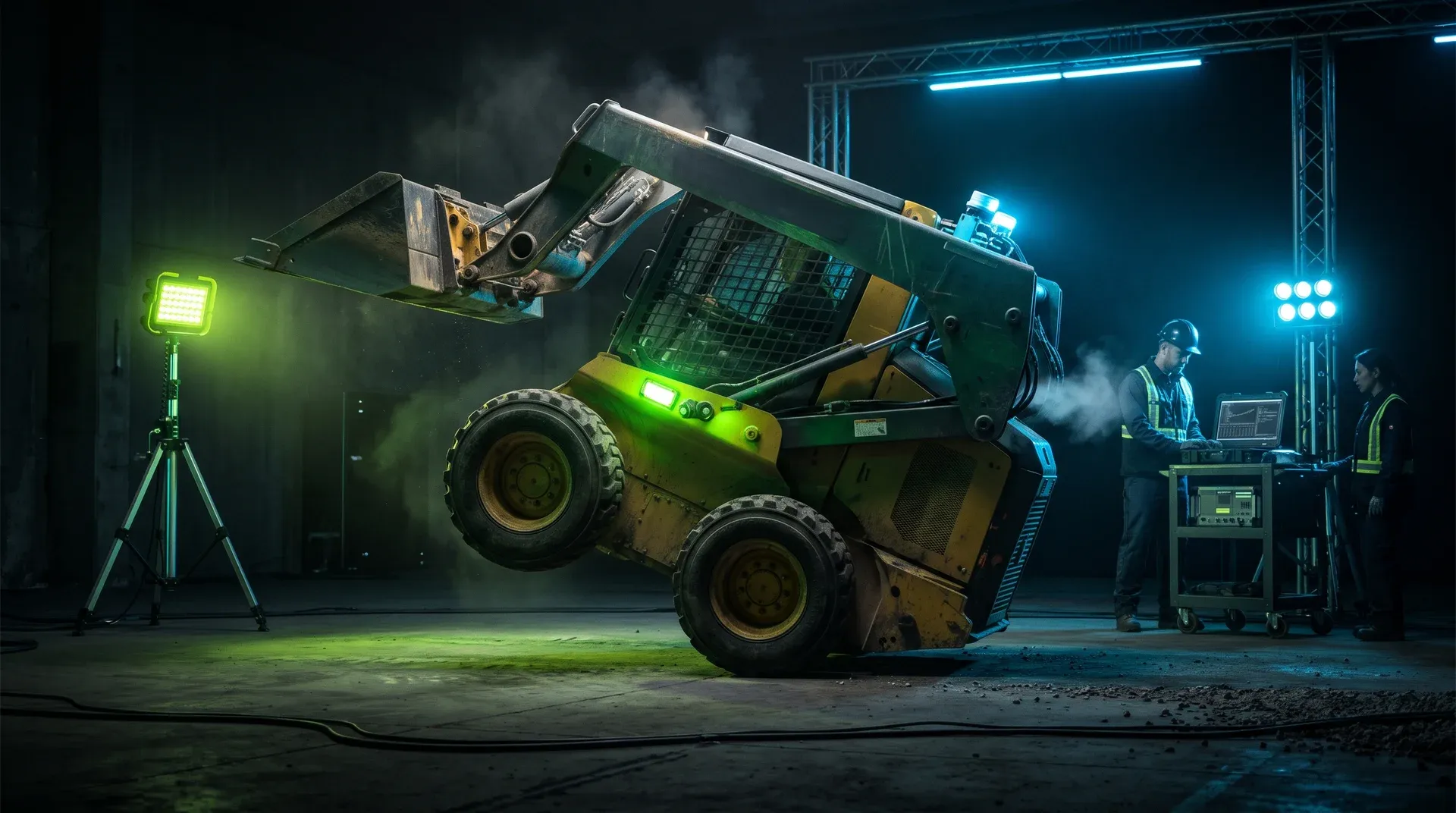
Researchers trained AI in simulation to balance a five-ton John Deere skid-steer loader on two wheels. This demonstrates how virtual training can prepare heavy equipment for real-world tasks. The breakthrough shows AI can handle extreme physical challenges in construction automation.
Hook Paragraph
An international team of researchers demonstrated that artificial intelligence trained entirely in simulation can enable a five-ton John Deere skid-steer loader to balance on two wheels. This isn't a lab experiment with a stripped-down prototype—it's a real piece of construction equipment performing an extreme physical task it was never designed for. The achievement proves that simulation-based AI training can bridge the gap between virtual learning and real-world performance, even for heavy machinery that costs tens of thousands of dollars and moves tons of earth daily. This is for construction equipment operators, fleet managers, and automation investors who want to understand how AI can unlock new capabilities in existing machinery without replacing the entire asset.
Why It Matters Right Now
The timing of this breakthrough reflects a broader shift in how we approach industrial automation. Rather than waiting for custom-built robots designed from scratch for niche tasks, companies can now use simulation to retrain existing equipment. This approach dramatically reduces the capital expenditure required to introduce AI capabilities into construction and manufacturing workflows. The researchers' success with the John Deere loader suggests that similar techniques could be applied to other heavy machinery, from excavators to dump trucks. As I discussed in my recent analysis of Atlas Robot Gets Wheels: What This Means for Your Business, the ability to add mobility and stability capabilities to existing robots through AI training represents a fundamental shift in how we deploy automation. The same principles that enabled the loader to balance on two wheels could potentially be applied to warehouse robots, as demonstrated by companies like Exotec that help Fnac Darty handle Black Friday rush with refurbished and rented robots.
The Play: Step-by-Step
- Identify existing heavy equipment that could benefit from new capabilities. Start with machinery that sits idle or operates in predictable patterns. The John Deere skid-steer loader was chosen because it's widely available and already has the basic mobility components needed for the experiment. Look for equipment that costs more than $50,000 and has at least one year of remaining useful life. This is your first step toward AI-enhanced automation.
- Set up a simulation environment that mirrors real-world physics. Use industry-standard simulation software like NVIDIA Omniverse, Isaac Sim, or Gazebo. These platforms can accurately model the weight distribution, center of gravity, and mechanical constraints of heavy equipment. The key is ensuring the simulation accurately reflects the real-world dynamics—especially important for a five-ton machine where small errors in simulation can lead to catastrophic failures in reality. Budget 2-4 weeks for setup and validation.
- Train the AI through reinforcement learning in the virtual environment. The researchers used reinforcement learning algorithms that reward the AI for maintaining balance while penalizing instability. Run thousands of training episodes until the AI consistently achieves the desired behavior. This process typically takes 2-6 weeks depending on computational resources. Monitor the AI's decision-making process to understand how it handles edge cases like uneven terrain or mechanical failures.
- Transfer the trained AI to the physical machine with safety protocols. Start with low-power demonstrations in a controlled environment with safety barriers and remote monitoring. The John Deere loader was tested in a facility with safety systems ready to shut down the experiment if needed. Gradually increase the complexity of tasks as confidence in the AI grows. Expect 1-2 weeks for initial deployment and testing.
- Monitor performance and iterate on the AI model. Track metrics like stability duration, task completion rate, and safety incidents. Use real-world data to improve the simulation models and retrain the AI. This continuous improvement cycle ensures the AI adapts to actual operating conditions rather than just simulation parameters.
Real-World Example
Here is what this looks like in practice: A construction company with a fleet of 10 John Deere skid-steer loaders wants to improve work efficiency on uneven terrain. Currently, operators avoid challenging jobsites due to stability concerns. By implementing the simulation-based AI training approach, the company can enable these machines to navigate slopes and uneven ground safely. The initial investment includes simulation software licenses ($5,000-15,000), training time for operators (40 hours), and safety equipment upgrades ($10,000). Based on the researchers' timeline, the project would take approximately 10-12 weeks from start to deployment. Realistic outcomes include a 25-40% increase in accessible work areas and reduced need for expensive ground preparation. The company could see a return on investment within 18-24 months through improved productivity and expanded service capabilities. This approach differs significantly from my analysis of Claude AI Can Now Review and Fix Pull Requests on Its Own, where AI augmentation focuses on software development rather than physical machinery.
Caveats
This technology has significant limitations that businesses need to understand. First, the simulation environment must be highly accurate—any discrepancies between virtual and real physics can cause the AI to fail catastrophically. Second, the approach requires specialized knowledge in both AI training and heavy equipment operation. Small contractors may not have access to the technical expertise needed for implementation. Third, safety remains paramount; even with AI assistance, human oversight is essential for complex construction tasks. Fourth, the initial investment in simulation software and training can be substantial for smaller operations. Finally, regulatory compliance varies by jurisdiction, and using AI to modify industrial equipment may require additional certifications or approvals.
Action Items
- Identify one piece of heavy equipment in your fleet that could benefit from enhanced stability or mobility capabilities
- Research simulation software options and allocate budget for licenses and training (expect $5,000-15,000 initial investment)
- Contact a local university or research institution with robotics programs to explore partnership opportunities for AI training
Frequently Asked Questions
How much does simulation-based AI training for heavy equipment cost?
The cost varies significantly based on the simulation software chosen and the complexity of the training. Entry-level simulation licenses can start around $5,000, while enterprise solutions may cost $50,000 or more annually. Training time for operators typically requires 40-80 hours of instruction. The total initial investment for a small fleet implementation could range from $25,000 to $100,000, depending on the number of machines and scope of modifications. This compares favorably to purchasing new AI-capable equipment, which can cost hundreds of thousands of dollars per unit.
Is this technology ready for commercial deployment?
While the research demonstrates technical feasibility, commercial deployment requires additional validation for specific use cases. The John Deere loader experiment was conducted in controlled conditions with extensive safety measures. Real-world construction sites present unpredictable variables like weather, terrain changes, and operator interaction that require additional testing. Companies considering implementation should start with pilot programs on single machines before scaling across their fleet. As I noted in discussing John Deere's Orchard AI Acquisition Powers Farm Automation, partnerships with equipment manufacturers and research institutions can accelerate deployment timelines.
What safety measures are needed when deploying AI-trained heavy equipment?
Multiple layers of safety protocols are essential. Physical safety systems should include emergency stop mechanisms, remote monitoring capabilities, and protective barriers around testing areas. The AI itself needs fail-safe programming that defaults to safe shutdown when uncertainty levels exceed thresholds. Human operators must maintain override capabilities at all times. Regular safety audits and compliance checks with OSHA and local regulations are mandatory. Insurance coverage for AI-modified equipment may require special policies, so consult with commercial insurance providers before deployment.
How does this compare to traditional automation approaches?
Traditional automation typically involves purchasing purpose-built robotic systems or adding mechanical attachments to equipment. This approach requires significant capital investment and offers limited flexibility. Simulation-based AI training allows existing equipment to gain new capabilities without replacement. However, it does require ongoing AI maintenance and updates, which traditional mechanical solutions do not. The trade-off is between upfront capital expenditure versus ongoing technical expertise requirements. For companies with diverse equipment fleets, the AI approach can provide more versatile automation capabilities.
Sources
- Heavy metal acrobatics: Researchers teach five-ton construction vehicle to balance on two wheels, roboticsandautomationnews.com (accessed 28 Nov 2026)
- Exotec helps Fnac Darty handle Black Friday rush with refurbished and rented robots, roboticsandautomationnews.com (accessed 28 Nov 2026)
- GXO doubling down on robotics in 2027, therobotreport.com (accessed 28 Nov 2026)