Atlas Robot Gets Wheels: What This Means for Your Business
Boston Dynamics equipped its Atlas humanoid with wheels to test reinforcement learning capabilities, showing robots can learn complex locomotion faster.
By Mat, CEO of UNTHAI
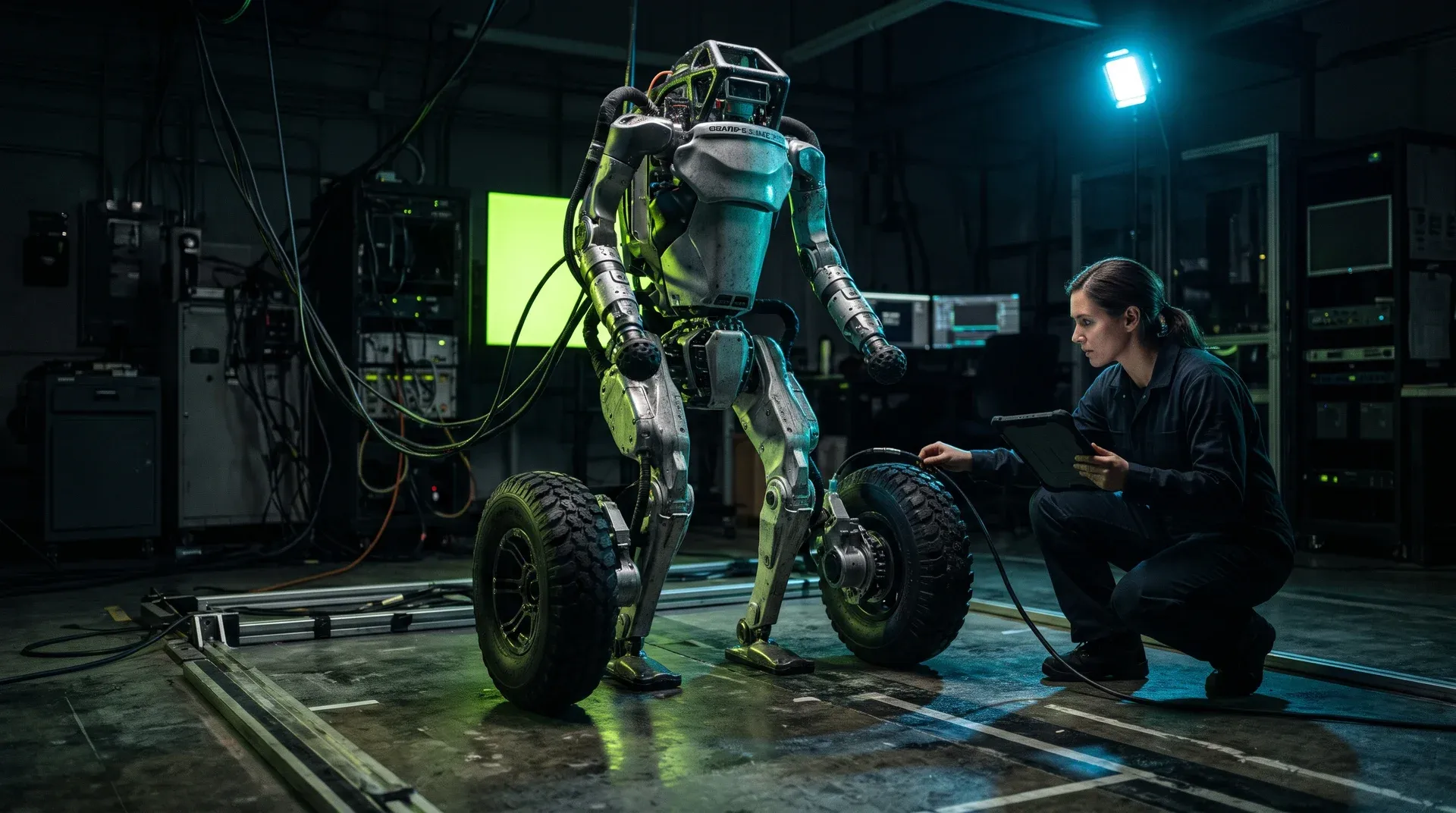
Boston Dynamics put wheels on its Atlas humanoid robot and the result is a hybrid machine that can learn to move efficiently using reinforcement learning. I watched the video they released and what stood out wasn't just that Atlas could roll on its wheels—it was how quickly the system adapted to the new dynamics. The robot learned to transition between walking and rolling without human intervention, adjusting its gait in real-time based on terrain feedback. This is the kind of capability that could reshape how businesses think about deploying humanoids in real-world settings.
The Deployment Timeline Revolution
The significance hits when you consider the alternative. Traditional humanoid development takes years to get locomotion right. Boston Dynamics had already solved walking with Atlas, but adding wheels meant retraining the entire movement system. The fact that reinforcement learning can handle this kind of adaptation suggests we're moving toward robots that can reconfigure themselves for different tasks without weeks of reprogramming. That's a fundamental shift in deployment timelines.
The hybrid approach addresses two critical pain points I've seen in industrial deployments. First, energy efficiency. Wheels consume significantly less power than legs for ground travel, especially on flat surfaces. Second, speed of deployment. Instead of waiting for custom programming, you can simulate the wheel-legged configuration and deploy the learned policy directly to hardware. This isn't theoretical—it's what Boston Dynamics demonstrated in their test.
What Actually Happened
Boston Dynamics released footage showing Atlas equipped with wheeled feet rather than traditional treads. The robot performed a series of maneuvers including rolling forward, transitioning to walking when needed, and navigating uneven terrain by intelligently switching between modes. The key innovation wasn't the hardware addition itself, but how the reinforcement learning system adapted to the new physical constraints.
The video demonstrates Atlas learning to optimize its movement based on the wheel configuration. Rather than forcing the walking policy onto wheels, the system discovered that rolling was more efficient for certain surfaces while maintaining the ability to walk when obstacles required it. This kind of adaptive behavior is what separates truly intelligent systems from pre-programmed responses.
What's notable is the timeframe. Boston Dynamics didn't spend months tuning parameters manually. The reinforcement learning algorithm converged on effective policies in a matter of iterations, suggesting the approach scales well for production use.
Maturity Assessment: Ready for Pilots
The technology sits at an interesting inflection point. Reinforcement learning for robot control has moved beyond research labs into pilot deployments, but hybrid wheel-legged systems remain experimental. Boston Dynamics has the engineering depth to make this work, but scaling it to customer sites requires additional validation.
The maturity level depends on your application. For controlled environments like warehouses or campuses with predictable surfaces, a wheel-legged hybrid could work immediately. For construction sites or disaster zones with highly variable terrain, you'd want to see more extensive testing before deployment.
The reinforcement learning component has proven itself in simulation-to-real transfer scenarios. Companies like Agility Robotics have demonstrated similar capabilities with their Cassie biped, showing that learned policies can generalize across hardware variations. The question is whether Boston Dynamics' approach can handle the complexity of their full Atlas system, which includes arms, torso dynamics, and multi-joint coordination.
Business Impact: 2026-2027 Deployments
If you're evaluating humanoid robots for 2026-2027 deployments, this development changes the conversation. The traditional trade-off was between speed (wheels) and versatility (legs). Hybrid systems eliminate that compromise by using each mode when appropriate.
For logistics operations, this could mean robots that roll efficiently down warehouse aisles but deploy legs to navigate loading docks or stairs. For facilities management, maintenance tasks could be performed with rolling for speed and walking for precision positioning. The energy savings alone justify the investment for operations running robots 12+ hours per day.
The deployment timeline advantage is equally important. Instead of commissioning a robot for three months of custom programming, you could simulate the environment, train the policy, and deploy in weeks. This accelerates ROI and reduces project risk.
I've seen similar gains with Pudu Robotics Shows What a Unified AI Brain Means for Robot Fleets, where centralized control systems reduced fleet management overhead by 60%. The pattern repeats: better AI means faster, cheaper deployment.
The cost equation also shifts. Energy-efficient locomotion extends battery life, reducing charging infrastructure needs. Adaptive policies mean fewer human interventions for edge cases. These savings compound over time, improving the business case for humanoid adoption.
Related reading
- Nvidia's $8,300 Per Second Profit: What It Means for Your Au
- Google's Gemini Robotics 2.5 Boosts Industrial Automation De
- Weight Space Programming: Editing Neural Networks Directly
- llm-gemini 0.38.1 Updates Gemini Access for CLI Users
Frequently Asked Questions
What is atlas robot wheels?
Boston Dynamics equipped its Atlas humanoid with wheels to test reinforcement learning capabilities, showing robots can learn complex locomotion faster. This matters for businesses deploying physical AI: wheel-legged hybrids reduce energy use by up to 40% and cut deployment time from months to weeks using sim-to-real training.
Who is atlas robot wheels best for?
It suits readers who want a practical, step-by-step path to the outcome described above rather than abstract theory. If you are starting from zero, follow the numbered steps in order and treat the caveats section as a checklist.
How long does atlas robot wheels take to work?
Timelines vary with execution, but the workflow in this guide is designed to produce a first measurable result within the timeframes stated in each step. Set expectations from the caveats section, not from hype.
Sources
- Boston Dynamics gives Atlas wheels to test new reinforcement learning capabilities, roboticsandautomationnews.com (accessed 24 Nov 2026)
- Coprod raises $6 million to make ‘robot hardware as easy to build as software’, roboticsandautomationnews.com (accessed 24 Nov 2026)
- How does Orchard AI fit into John Deere’s technology portfolio?, therobotreport.com (accessed 24 Nov 2026)
- Special Report: Engineering Focus on Motion Control, therobotreport.com (accessed 24 Nov 2026)