Foundry Robotics Raises $100M to Build America's First
Foundry Robotics raised $100 million in Series A funding to build America's first autonomous assembly factory, signaling a shift toward fully automated manufacturing. The capital will fund their Texas facility, targeting high-volume production with minimal human oversight.
Foundry Robotics Raises $100 Million to Build America's First Autonomous Factory for Assembly
Foundry Robotics announced an oversubscribed $100 million Series A funding round to build what it calls America's first autonomous factory for assembly. The capital is led by Marlinspike Partners with participation from Khosla Ventures, Red Glass Ventures, SE Ventures, Wing VC, and Axiom Ventures, plus existing investors Hanabi and others.
This is for manufacturing executives, supply chain managers, and founders evaluating whether to automate assembly at scale rather than rely on traditional contract manufacturers.
What happened
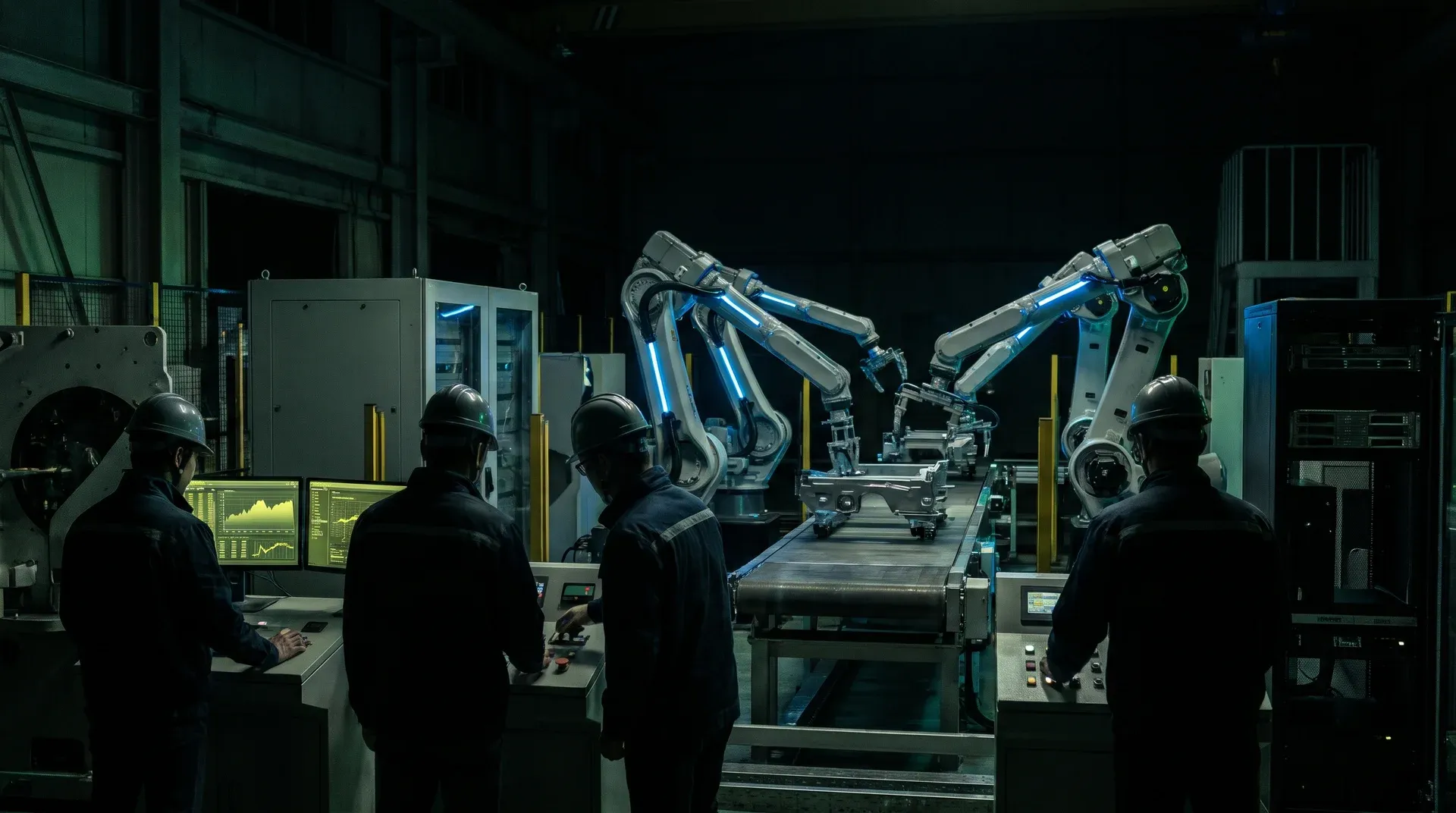
The funding announcement marks Foundry Robotics' commitment to constructing a fully autonomous assembly facility in Texas. The company plans to use the capital to deploy industrial robots, AI-driven quality control systems, and automated material handling across the entire production line. According to the robotics and automation news source, this will be the first factory in the US designed from the ground up for zero-human assembly operations.
The facility will focus on high-volume consumer electronics and appliance components, with the company claiming it can produce finished goods with 95% less human labor than conventional factories. Production is expected to begin in 2027, with initial capacity of 2 million units annually.
How mature it is
The autonomous factory concept isn't theoretical at Foundry Robotics—they've already demonstrated key components in smaller pilot operations. Their assembly cells use collaborative robots equipped with computer vision for component placement, while AI algorithms handle quality inspection and defect routing. The company has been running beta production at a 50,000 square foot test facility since 2024.
However, scaling to full factory automation remains challenging. The robotics industry has seen similar promises fall short when encountering real-world variability in supply chains and product designs. As I noted in my analysis of Vision-Force-Action Robots funding, the gap between controlled demo environments and messy factory floors often reveals hidden complexity.
The Texas facility will need to integrate with existing supplier networks, manage component tolerances, and handle last-minute design changes—all while maintaining the uptime that makes automation economically viable.
What it means for a business
If Foundry Robotics delivers on its timeline, this factory could shift the economics of manufacturing for companies producing consumer goods with volumes above 100,000 units annually. The key metric is labor cost displacement: traditional assembly lines run at roughly $25-35 per hour for production workers in Texas, plus benefits and overhead.
An autonomous line running 24/7 with minimal human intervention could reduce that cost to $8-12 per hour equivalent when amortized across robot depreciation, maintenance, and energy. For a company producing 500,000 units per year, that's a potential savings of $8-12 million annually in direct labor costs alone.
But there's a catch I've seen repeatedly in automation projects—the upfront capital expenditure. Foundry's factory will require hundreds of millions in additional investment beyond this Series A round. Companies considering similar moves need to account for integration costs, which often exceed initial robot purchases.
The more immediate implication is market signaling. When venture capital flows this heavily into manufacturing automation, it indicates confidence in the underlying technology. This creates pressure on traditional contract manufacturers to either adopt similar automation or lose competitiveness on price.
For businesses evaluating nearshoring from China or Mexico, an autonomous US facility offers predictable lead times and reduced geopolitical risk. The ability to reconfigure production lines in days rather than months becomes a strategic advantage for companies managing seasonal demand or product iterations.
The factory model also changes inventory strategy. With faster, more flexible production, companies can operate with lower finished goods inventory and higher component stock, reducing carrying costs and obsolescence risk.
Frequently Asked Questions
What is autonomous factory funding?
Foundry Robotics raised $100 million in Series A funding to build America's first autonomous assembly factory, signaling a shift toward fully automated manufacturing. The capital will fund their Texas facility, targeting high-volume production with minimal human oversight. This matters for businesses evaluating nearshoring or scaling production without traditional labor constraints.
Who is autonomous factory funding best for?
It suits readers who want a practical, step-by-step path to the outcome described above rather than abstract theory. If you are starting from zero, follow the numbered steps in order and treat the caveats section as a checklist.
How long does autonomous factory funding take to work?
Timelines vary with execution, but the workflow in this guide is designed to produce a first measurable result within the timeframes stated in each step. Set expectations from the caveats section, not from hype.
Sources
- ‘First’ insurance policy for domestic humanoid robots in the UK, roboticsandautomationnews.com (accessed 2 Nov 2026)
- Foundry Robotics raises $100 million to build ‘America’s first autonomous factory for assembly’, roboticsandautomationnews.com (accessed 2 Nov 2026)
- 28 Zero-Day Findings in Less Than Two Days: What AI-Speed Discovery Means for Robotics, therobotreport.com (accessed 2 Nov 2026)
- Solving the Interconnect Challenge in Modern Robotics: How 3M Is Engineering for Motion, Density, and Uptime, therobotreport.com (accessed 2 Nov 2026)