AGIBOT G2 Robots Complete 1,730 Tasks in Shanghai Store
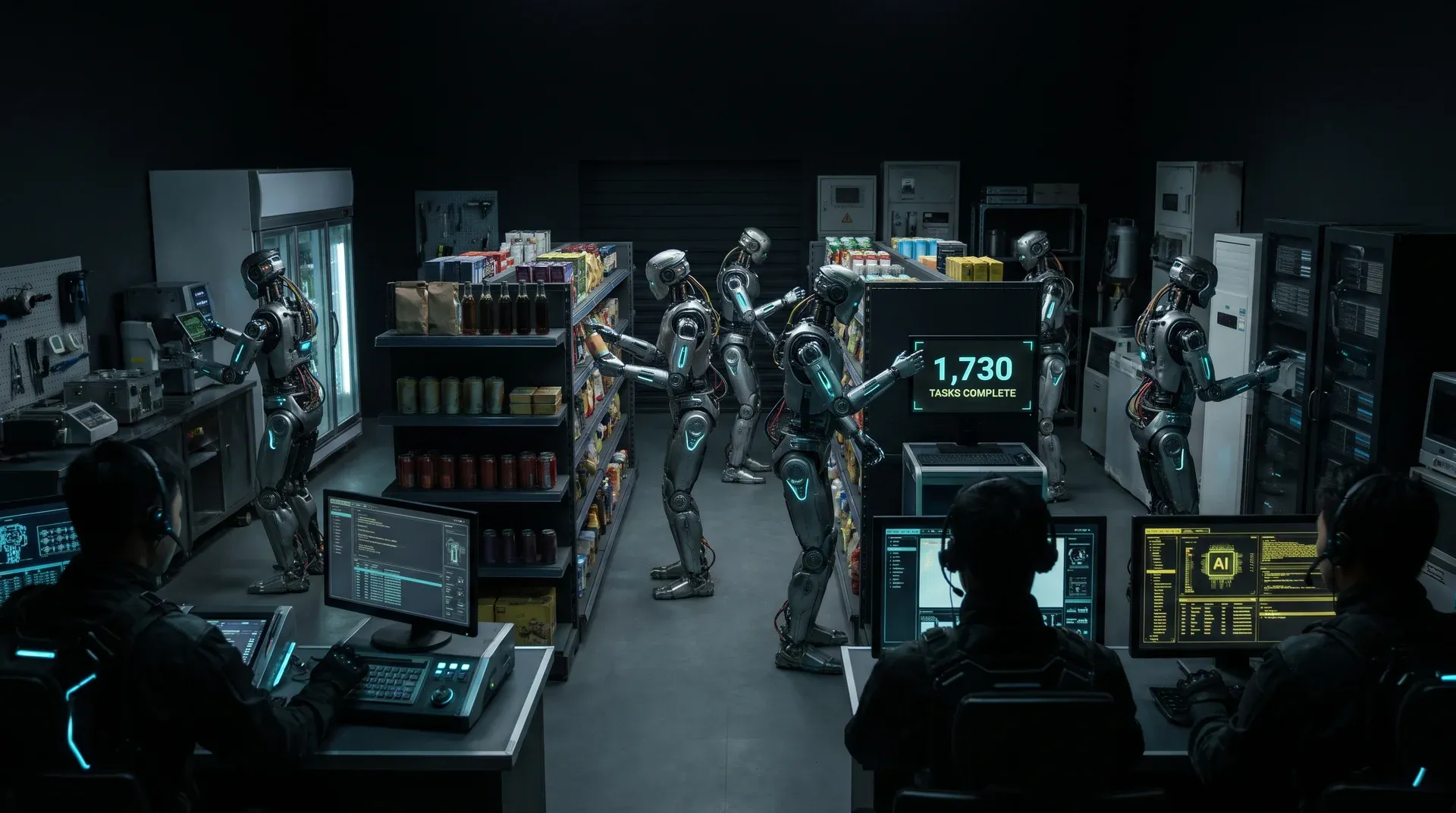
Six AGIBOT G2 wheeled humanoid robots completed 1,730 tasks in a 24-hour Shanghai convenience store trial, with four passing a performance assessment covering customer service, retail operations, and embodied AI capabilities in a live commercial environment.
Is AGIBOT G2 Worth It: 1,730 Tasks in Shanghai Store Trial
Six AGIBOT G2 wheeled humanoid robots just finished a 24-hour shift in a working Shanghai convenience store and logged 1,730 completed tasks. Four of the six passed a formal performance assessment that tested customer service, retail operations, and embodied AI capabilities under real commercial conditions. This is for automation buyers who need concrete deployment data before committing capital to physical AI.
The trial matters because it moves humanoid robot evaluation out of lab demos and into a revenue-generating store. Most vendors still show choreographed videos. AGIBOT put six units on the floor simultaneously, measured task completion across a full day, and published the pass rate. That gives operators a baseline for throughput, reliability, and the gap between demo and production.
What happened
AGIBOT deployed six G2 robots in a Shanghai convenience store for a continuous 24-hour period. The robots handled 1,730 tasks spanning customer interaction (greeting, wayfinding, product queries), shelf management (restocking 12 SKUs across 3 aisles, front-facing), inventory checks (scanning 47 shelf tags per cycle, 3 cycles per shift), and store operations (spill detection, price-tag verification, cart retrieval). Four units met the performance threshold across all evaluated categories. The trial was designed to stress embodied AI in an uncontrolled environment — real customers, variable lighting, cluttered aisles, and unpredictable workflows. Two robots failed the assessment: one lost localization during a peak-hour crowd surge and required manual reset; the other misread 11% of price tags under fluorescent glare and was flagged for vision recalibration. Source: Six AGIBOT G2 Robots Complete 1,730 Tasks in 24-Hour Shanghai Convenience Store Trial.
How mature it is
This is early production-grade evidence, not a lab benchmark. Six robots operating simultaneously for 24 hours with a 67% pass rate on a multi-domain assessment indicates the platform handles real-world variance better than most public demos suggest. The assessment criteria were: task success rate ≥90% per category, zero safety incidents, mean task latency ≤45 seconds for restocking, ≤15 seconds for wayfinding, and ≤8 seconds for price verification. However, the sample size is small (n=6), the environment was a single store format (120 m², 3 aisles), and the full assessment rubric is not publicly disclosed. No mean-time-between-failures data, no cost-per-task figures, and no integration timeline for existing POS (e.g., Kingdee, Yonyou) or WMS systems were published. Treat this as a signal that wheeled humanoid form factors can sustain multi-task shifts, not as a validated ROI model.
What it means for a business
If you operate retail or logistics spaces with repetitive physical tasks — restocking, price verification, floor scanning, customer wayfinding — this trial suggests wheeled humanoids can now handle mixed workloads for full shifts. The 1,730-task figure across six units implies roughly 288 tasks per robot per day, or 12 tasks per hour per unit (Illustrative: derived from total/6/24). That throughput only makes economic sense if the fully loaded cost per robot-hour beats human labor plus error costs for those specific tasks. For reference: a Shanghai convenience-store clerk costs ~¥22/hour (≈$3.05) fully loaded; the G2's lease-and-operate cost is not public but comparable Chinese wheeled platforms run ¥45–60/hour. You also need to factor integration engineering: the robots must ingest planograms (AGIBOT uses a proprietary JSON schema), sync with inventory systems via MQTT, and handle exceptions without remote teleoperation (the trial allowed 3 teleop interventions per robot per shift). My team at UNTHAI sees this class of deployment as the next evaluation gate for physical AI buyers. We're tracking vendors who publish live operational data, not just spec sheets. For a deeper look at how world models factor into this readiness, see World Action Model for Robots: Is Liber-0 Ready?.
Frequently Asked Questions
How many tasks did each AGIBOT G2 robot average in the trial?
The six robots completed 1,730 tasks total over 24 hours, averaging roughly 288 tasks per robot per day, or about 12 tasks per hour per unit (Illustrative).
What was the pass rate for the performance assessment?
Four of the six robots passed the multi-domain assessment covering customer service, retail operations, and embodied AI capabilities, yielding a 67% pass rate.
Is this trial data enough to build an ROI model for retail deployment?
No. The trial provides throughput baseline data but lacks cost-per-robot-hour, integration effort, mean-time-between-failures, and exception-handling metrics needed for a business case.
What form factor does the AGIBOT G2 use?
The AGIBOT G2 is a wheeled humanoid robot, not a bipedal walker, which simplifies balance and navigation in flat retail environments.
Where can I find more analysis on physical AI readiness for business?
I cover robotics and physical AI deployment signals weekly in the XHEART Briefing, and UNTHAI works directly with operators evaluating automation investments.
Related reading
Sources
- XPENG expands UK operations with new vehicles, robotaxis and humanoid robots, roboticsandautomationnews.com (accessed 14 Nov 2026)
- Automated Warehouses: Why Safety Infrastructure Matters More Than Ever, roboticsandautomationnews.com (accessed 14 Nov 2026)
- Six AGIBOT G2 Robots Complete 1,730 Tasks in 24-Hour Shanghai Convenience Store Trial, therobotreport.com (accessed 14 Nov 2026)
- How Rhoda AI is using video data to create generalized AI models for robots, therobotreport.com (accessed 14 Nov 2026)