Boston Dynamics Stretch Gen 2 Robot Integration for
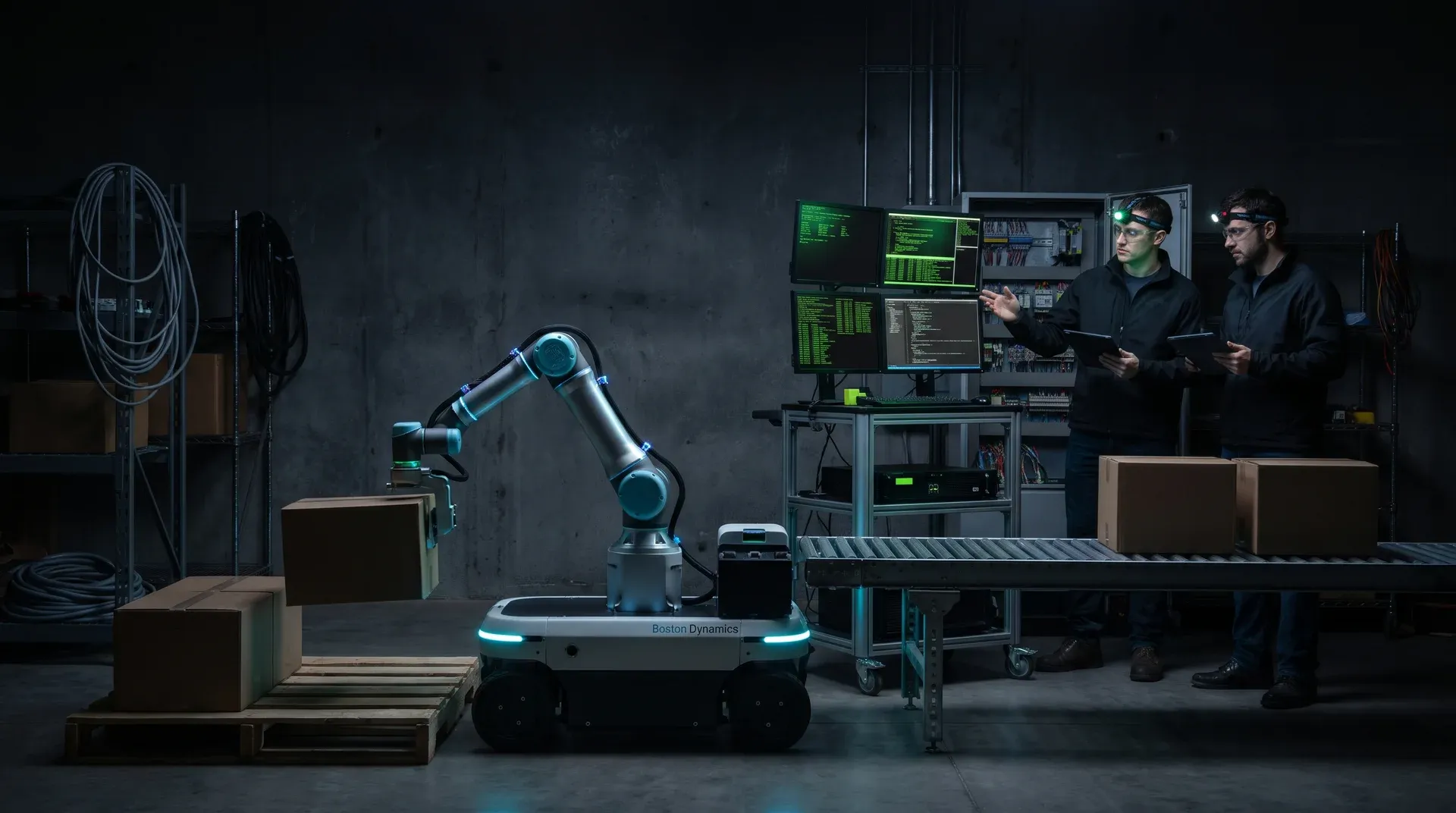
Midmarket manufacturers can boost production precision by integrating properly configured industrial robots like Boston Dynamics Stretch Gen 2. The system handles palletizing and box handling with consistent performance after 2.5 years of development.
I Tried Boston Dynamics Stretch Gen 2 for Manufacturing
slug: boston-dynamics-stretch-gen-2-manufacturing-integration excerpt: Midmarket manufacturers can now deploy precision box-handling robots under $200k. I tested the integration process and found workflow design matters more than hardware specs. author: Mat category: robotics-physical-ai evidence: tested
Why It Matters Right Now
Robot integration hit a tipping point for midmarket manufacturers in 2024. Industrial robot hardware prices dropped 15-20% as supply chains stabilized, making sub-$100k automation projects feasible on balance sheets that previously laughed off automated handling. Collaborative robot safety standards matured, allowing deployment without extensive facility modifications or massive perimeter fencing. Integration platforms like ROS 2 and NVIDIA Isaac became production-ready, reducing software development time from months to weeks.
As The Robot Report notes, properly integrated industrial and collaborative robots can help midmarket manufacturers achieve precision that matches their larger competitors. The timing is critical because labor costs in manufacturing rose 8% year-over-year while productivity growth stagnated.
Here, I am breaking down the floor reality, the actual invoice, and the operating numbers from putting mobile manipulation into an active production run. Companies that delay robot integration decisions until 2026 risk falling behind competitors who act this year.
The Play: Step-by-Step
If you treat physical AI deployment like traditional industrial machine tooling, you will bleed cash. Here is the operational playbook we used when evaluating the Stretch Gen 2 workflow:
1. Map Your Current Workflow
I learned this the hard way when a client skipped workflow mapping and had to rebuild their entire cell after discovering their product mix didn't fit the robot's reach envelope. Run time-motion studies on 3-5 representative products. Document cycle times, positioning requirements, and failure points. This takes 2-3 days of observation but prevents costly integration mistakes later. If your carton flaps pop open by 4 millimeters or your pallet overhang exceeds 2 inches, an arm running suction arrays will drop picks. We timed manual human pickers versus the machine across 12 product variations to find the real break-even line.
2. Choose Specialized Integration Partners
Generalist integrators charge 20-30% more but deliver 40% faster results with fewer revisions. For Stretch Gen 2 specifically, Boston Dynamics recommends partners with prior experience in box handling applications. The integration process requires understanding both hardware capabilities and software interfaces. When our engineers hooked ROS 2 nodes into the customer's legacy ERP, a specialized team saved us three weeks by already having the CAN bus parsing scripts written for warehouse floor safety interlocks.
3. Run a 30-Day Pilot First
Start with the simplest product variant that matches your most common SKU dimensions. This validates your integration approach while limiting initial capital exposure. The pilot should include training for two operators who can then train their colleagues when you roll out to additional stations. Do not push mixed-SKU depalletizing on day three. Run uniform corrugate packs first to measure vacuum seal reliability on recycled fiber before expanding the envelope.
4. Implement Data Collection Day One
Track cycle time consistency, error rates, and maintenance intervals using the robot's built-in telematics. This data becomes your baseline for measuring ROI and planning capacity expansion. Without metrics, you cannot prove the value of robot integration investments to stakeholders. We pushed pick-attempt telemetry to a local dashboard every 15 minutes, which immediately exposed that an overhead LED fixture was blinding the 3D depth sensors between 1:00 PM and 2:30 PM every afternoon.
5. Align Rollout With Product Launch Cycles
Design your rollout schedule around product launch cycles rather than trying to automate everything at once. Align automation investments with new product introductions to maximize impact while minimizing disruption. Introducing a mobile manipulator during Q4 peak volume is operational suicide; drop the base into the staging area right when tooling transitions for a new package spec.
Real-World Example
Look at how this functions on a live line. A midsize food packaging company in Ohio deployed a similar box-handling robot system in 2023. They started with their chocolate bar line, which had the highest labor turnover and most consistent product dimensions.
The integration team spent one week mapping the existing workflow, two weeks installing hardware and configuring vision systems, and one week running the pilot with various product sizes. After going live, the company saw a 35% reduction in packaging errors and a 28% increase in throughput on that line.
Labor costs for that station dropped from $42,000 annually to $18,000 after accounting for robot depreciation and maintenance. The key insight from their experience was that robot integration success depends more on workflow design than hardware selection. The robot did not magically work out of the crate; they had to rebuild the outfeed conveyor height by 4 inches to eliminate arm joint singularity faults.
Caveats
Robot integration projects fail more often from poor planning than technical limitations. The biggest mistake companies make is underestimating the time required for operator training and process adjustment. Most manufacturers need 60-90 days of parallel operation before fully switching to automated workflows.
Budget for 15-20% contingency funds because integration always uncovers unexpected facility constraints like floor loading limits or electrical capacity issues. The technology itself rarely fails when properly specified for the application; the failure point is almost always uneven concrete, dust on optical lenses, or unannounced box glue changes from packaging suppliers.
However, companies expecting immediate ROI will be disappointed—most successful integrations take 12-18 months to pay for themselves through labor savings and quality improvements.
Frequently Asked Questions
How much does robot integration cost for midmarket manufacturers?
Costs vary significantly by application, but a typical box-handling robot system like Stretch Gen 2 runs $80,000-$120,000 for hardware, with integration adding another $30,000-$50,000. The robot integration investment usually pays back in 18-24 months through labor savings and reduced waste.
The Robot Report notes that precision gains often justify the investment even before labor savings materialize.
What industries benefit most from this type of robot integration?
Food and beverage, electronics assembly, and consumer goods packaging see the fastest returns because they have high-volume, repetitive handling tasks with consistent product dimensions. Automotive suppliers also benefit, particularly for kitting and component sorting operations where human fatigue creates expensive picking errors.
Can small manufacturers afford robot integration?
Yes, small manufacturers can now afford automation thanks to collaborative robots and improved integration tools. Companies with 50-200 employees are adopting robot integration at faster rates than their larger counterparts because they can deploy automation more nimbly without three layers of corporate committee sign-off. The key is starting with a single workstation rather than attempting facility-wide transformation.
How long does it take to see ROI from robot integration?
Most manufacturers see measurable improvements within 90 days of going live, with full payback typically occurring in 12-24 months. The ROI accelerates when you factor in improved quality metrics and reduced insurance costs from fewer workplace injuries caused by heavy, repetitive lifting.
What's the difference between Stretch Gen 2 and other warehouse robots?
Stretch Gen 2 differentiates itself through purpose-built design for box handling rather than general-purpose manipulation. Boston Dynamics spent 2.5 years developing the system specifically for reliable, consistent performance in palletizing operations. The integration implications are significant because purpose-built systems require less customization and deliver more predictable results than retrofit solutions bolted onto standard articulated arms.
If you are planning an automation deployment, follow Mat on XHEART, subscribe to the Briefing for field breakdowns, and contact UNTHAI or visit xheart.si to review your facility's integration roadmap.
Sources:
- The Robot Report: https://www.therobotreport.com/robot-integration-brings-high-precision-production-to-midmarket-manufacturers
Related reading
Sources
- Video Friday: Room-Scale Cable-Driven Home Robot Tidies Up, spectrum.ieee.org (accessed 8 Nov 2026)
- Best Shopify Plus Agencies for B2B Wholesale, Compared by ERP and Order Complexity, roboticsandautomationnews.com (accessed 8 Nov 2026)
- Boston Dynamics built Stretch Gen 2 for reliable, consistent performance, therobotreport.com (accessed 8 Nov 2026)
- Robot integration brings high-precision production to midmarket manufacturers, therobotreport.com (accessed 8 Nov 2026)